
Do I need to change my strategy when US market daylight saving time changes?
Last updated ·
Check the strategy time zone, trading calendar and corresponding Beijing-time trading window.
Check the strategy's time zone
A strategy using a regional time zone such as America/New_York can convert daylight saving time according to regional rules. For a fixed UTC offset or Beijing-time schedule, inspect the time configuration.
Check the trading session, direction-lock time, signal candle and actual order-submission time separately.
Convert New York time to Beijing time
09:30 in New York corresponds to 21:30 in Beijing during US daylight saving time and 22:30 during standard time. Other scheduled events based on New York local time shift accordingly in Beijing time.
Inspect how the current strategy code and configuration handle time zones. Verify direction-lock, signal and exit windows.
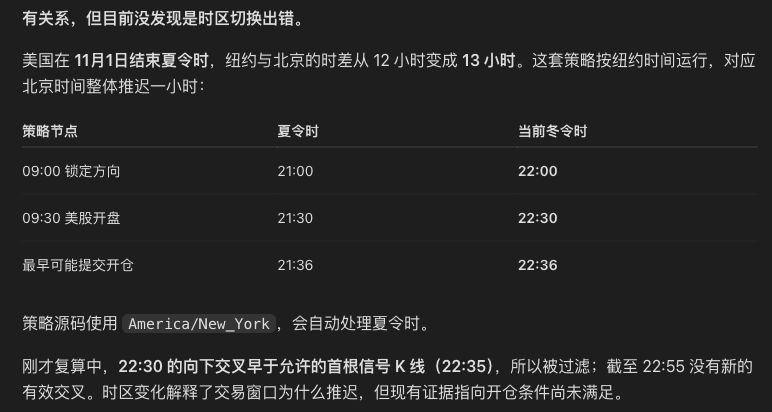
If there are no orders after the session opens
Once the trading session begins, the strategy may still evaluate directional filters, closed candles, fresh crossovers or delay conditions.
A strategy requiring a fresh crossover may filter out a crossover before the trading window and wait for the next valid one. Check signal timestamps and evaluation results in the logs.
Verify time settings
Confirm that the computer clock is accurate, the strategy time zone is correct, the trading calendar includes holidays and early closes, and current market data is available.
Keep the existing schedule when regional time-zone rules already handle the change. If a fixed schedule needs adjustment, save a new revision and verify its trading window.