
How do order leverage, allocation and maximum exposure work?
Last updated ·
Calculate planned order notional, total exposure limits and exchange margin requirements.
What each setting controls
Order leverage and allocation determine the planned order size. Maximum exposure limits total positions and relevant pending entry orders. Exchange leverage affects margin requirements. Check the strategy's parameter definitions and run configuration to identify its capital basis.
| Setting | Controls |
|---|---|
| Order leverage and allocation | Planned notional value of each order |
| Capital basis | Account equity, available margin or another specified value |
| Maximum exposure | Total notional limit for positions and pending entry orders |
| Exchange leverage | Margin required for the contract and margin mode |
Calculate order size and margin
For a strategy using account equity × order leverage × allocation, equity of 5,000 USDT, order leverage of 3× and allocation of 5% produce a planned notional value of 750 USDT.
At 3× exchange leverage, the basic margin for 750 USDT of notional exposure is about 250 USDT. Fees and exchange requirements also affect the amount needed to submit the order.
If the planned order exceeds the total exposure limit, check whether the strategy rejects it or reduces the quantity. If required margin exceeds available funds, adjust the order size and check again.
How position size affects return and drawdown
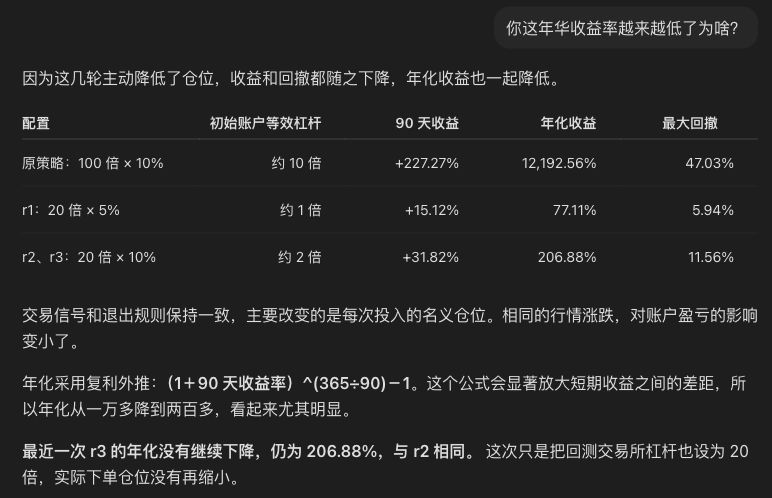
With the same signals, smaller notional positions generally produce smaller gains and losses. When sizing uses current equity, earlier gains and losses also change later order sizes.
Compare period return, maximum drawdown and peak actual exposure when evaluating parameters.
Verify changed settings
Check the draft, saved revision, selected preset and running instance in sequence. Then check actual exchange leverage for the same contract and cross or isolated margin mode.
Review expected order notional, required margin and total exposure together. Confirm that the saved configuration matches the running instance.